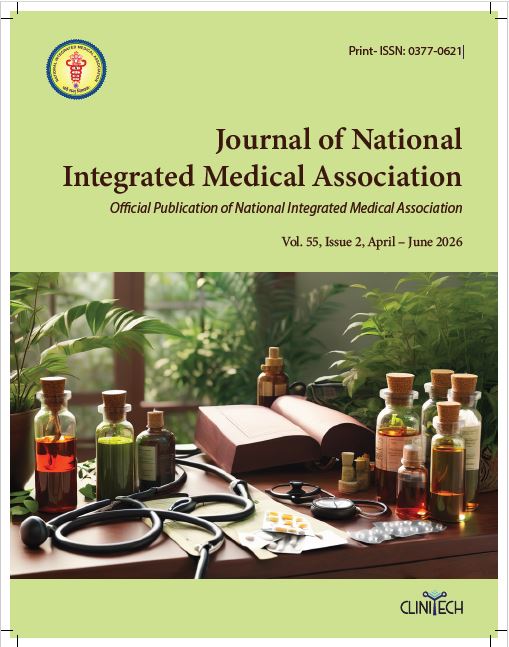
Journal of National Integrated Medical Association
Journal of National Integrated Medical Association (Print ISSN:0377-0621) is the official publication of the National Integrated Medical Association (NIMA). The Association was established in 1948 to promote integrated medical education and practices. The journal is one expression of this vision. JNIMA is a quarterly journal. It encourages publication of articles on Ayurveda system of practice integrated with various aspects of modern medicine such as diagnostic methods. The journal publishes original articles, review articles, and case study for the utilization of new knowledge by its readers.. The Copyright of the journal belongs to NIMA and it is protected under Indian copyright law.
ISSN No: 0377-0621 | Volume: 55 | Issue II |Session: Apr-Jun 2026
Pulisher: CliniEdge Private Limited
EDITORIAL BOARD
EDITORIAL BOARD
Journal of National Integrated Medical Association | Vol. 55 | Issue II | Page No. - 1-3
E D I T O R I A L
E D I T O R I A L
Journal of National Integrated Medical Association | Vol. 55 | Issue II | Page No. - 4
Comparative study of Shastrokta Nidana and contemporary Nidana of Asrigdara
In Ayurvedic classics, all gynecological disorders come under a big heading of Yonivyapada. Asrigdara is a very severe and life-threatening disease that may be fatal to the patient if not treated properly and timely. Complications of Asrigdara include weakness, giddiness, mental confusion, feeling of darkness, dyspnea, thirst, burning sensation, delirium, anemia, drowsiness, convulsions and other disorders caused by Vata Vitiation due to excessive bleeding per vaginum. Aggravated Vayu, withholds the Rakta vitiated due Nidana Sevana, increases its amount, and then, reaching the Raja-carrying vessels of the uterus, immediately increases the amount of Raja. After reviewing different research articles and Ayurvedic classics, the general principles of treatment of bleeding per vaginum are the eradication of the cause, Dosha Shodhana, Dosha Shamana, Rakta Sthapana, and Rakta Sangrahana. Nidana Parivarjana is said to be first line of treatment and for that we should have entire knowledge of Hetus. Therefore, for the eradication of causes or Hetu of Asrigdara, we should have in-depth knowledge about the causes seen in our day-to-day lifestyle and how much does it affect the bleeding
Journal of National Integrated Medical Association | Vol. 55 | Issue II | Page No. - 5-7
Relevance of Garavisha in modern food adulteration crimes: an Ayurvedic and contemporary forensic-toxicological review
The Ayurvedic toxicological concept of Garavisha (slow-acting compounded poison) offers a clinically and forensically relevant framework for interpreting chronic toxic exposures seen in modern food adulteration crimes. Garavisha is classified under Kalpita Visha (artificially formulated poison) and is characterized by delayed symptom manifestation, cumulative toxicity, systemic tissue vitiation, impairment of Agni (digestive–metabolic biofire), and depletion of Ojas (vital immunity essence). These attributes strongly correlate with the toxicological profiles of contemporary adulterants such as melamine, urea, synthetic dyes, formalin, pesticide residues, mineral oils, and argemone oil. Unlike acute poisoning, food adulteration typically results in gradual metabolic, hepatic, renal, neuroendocrine, and immune disturbances, producing early non-specific symptoms such as indigestion, fatigue, allergies, edema, and unexplained chronic inflammation — a diagnostic challenge also emphasized in classical descriptions of Garavisha toxicity. Modern forensic toxicology validates similar pathophysiological mechanisms, including oxidative stress, mitochondrial dysfunction, bioaccumulation, hepato-nephrotoxicity, vascular endothelial injury, immune dysregulation, carcinogenic transformation, and endocrine disruption. Due to delayed clinical presentation, victims of adulteration-linked toxicity often escape early suspicion, allowing perpetrators to evade legal traceability without laboratory evidence. Ayurveda emphasizes exposurehistory tracing and systemic channel involvement (Srotas Dushti)— principles analogous to modern chronic toxicology surveillance and food-crime investigation models. This review concludes that Garavisha is not only doctrinally comparable but also epistemologically valuable in strengthening Ayurvedic forensic interpretation, early clinical suspicion in victims, toxic profiling in chronic food crimes, and future biomarkerbased integrative research.
Journal of National Integrated Medical Association | Vol. 55 | Issue II | Page No. - 8-11
Critical review of Vishaghna Gana and its significance in modern day
Drugs that act against toxic effects of substances or any other poisons are called Vishaghna. Vishaghna Mahakashaya Dravyas help in the neutralization and excretion of toxins from the body. It includes Haridra (Curcuma longa), Manjishtha (Rubia cordifolia), Suvahaa (Alpinia galanga), Sukshma Ela (Elettaria cardamomum), Paalindee (Operculina turpethum), Chandana (Santalum album), Kataka (Strychnos potatorum), Shirisha (Albizzia lebbeck), Sinduvaara (Vitex negundo), and Shleshmataka (Cordia dichotoma). Vishaghna Mahakashaya has huge area of therapeutic potential. The objective of this review article is to discuss various aspects of Vishaghna Mahakashaya as described in Ayurveda classics and its relevance in modern times, with special reference to its antimicrobial activity. Furthermore, future research may help decipher the properties of Vishaghna Mahakashaya in combating wide range of diseases.
Journal of National Integrated Medical Association | Vol. 55 | Issue II | Page No. - 12-17
A comparative clinical study to evaluate the efficacy of Nasya and Matra Basti with Bilvadya Ghrita in Parkinson’s disease
Parkinson’s disease is a chronic progressive neurodegenerative disorder affecting the central nervous system and motor functions, with increasing global prevalence, particularly among the elderly population. In Ayurveda, the condition closely resembles Kampavata and Vepathu. As contemporary management has certain limitations, exploration of effective Ayurvedic interventions becomes important. Among the various treatment modalities, Basti Chikitsa is considered the prime therapy for Vatavyadhis due to its Vatahara action and systemic therapeutic effects. Matra Basti, a type of Sneha Basti administered in minimal dosage, has been considered for therapeutic application. Nasya, one of the Panchakarma procedures, is believed to deliver medicine to the brain and is especially beneficial in disorders of the supraclavicular region. These Ayurvedic approaches may offer promising possibilities in the management of Parkinson’s disease. Hence the present study titled, A comparative clinical study to evaluate the efficacy of Nasya and Matra Basti with Bilvadya Ghrita in Parkinson’s disease, was undertaken.
Journal of National Integrated Medical Association | Vol. 55 | Issue II | Page No. - 18-25
Management of Vataja Pratishyaya with Anutaila Pratimarshya Nasya and Abhyantar Yoga w.s.r. to allergic rhinitis: a case study
Vataja Pratishyaya, described under Nasagata Roga in Ayurveda, closely resembles allergic rhinitis in modern medicine, which is a Type I hypersensitivity reaction of the nasal mucosa. Allergic rhinitis is highly prevalent and often recurrent, leading to complications such as sinusitis, nasal polyps, and bronchial asthma. Conventional management provides symptomatic relief but does not always prevent recurrence. Ayurveda offers a holistic approach based on the involvement of Dosha– Dushya–Agni. The objective of the present study was to understand the pathophysiology of Vataja Pratishyaya in relation to allergic rhinitis and to evaluate the efficacy of an Ayurvedic treatment protocol in the management of Vataja Pratishyaya. In this case, a 17-year-old female patient with a 4–5-year history of sneezing (Kshavathu), watery nasal discharge (Tanusrava), nasal obstruction (Nasavrodha), headache (Shirshoola), post-nasal discharge, and hoarseness of voice was treated at the Kayachikitsa OPD, RT Ayurveda Mahavidyalaya, Akola. The treatment protocol included Agnideepana, Amapachana, Vatanulomana, and Vata–Kaphahara therapies. Oral medications such as Panchasaka Churna, Laxmivilas Rasa, Guduchi Ghana Vati, Laghu Sutshekhar Rasa, Sukshma Triphala Vati, and Sitopaladi Churna were administered for 30 days, along with Pratimarsha Nasya using Anu Taila for 25 days. Clinical assessment was carried out using subjective symptom scoring and anterior rhinoscopic findings. Significant improvement was observed in all major symptoms including nasal discharge, nasal obstruction, sneezing, headache, post-nasal discharge, Swarabheda, and nasal mucosal color by the end of 30 days. Anterior rhinoscopy showed normalization of nasal mucosa. No adverse drug reactions were reported during the treatment or follow-up period. In conclusion, the present case demonstrates that the Ayurvedic treatment protocol provided effective symptomatic relief and overall improvement in allergic rhinitis correlated with Vataja Pratishyaya. The study suggests that Ayurveda offers a safe, holistic, and potentially long-term management approach for allergic rhinitis with reduced recurrence, thereby improving quality of life.
Journal of National Integrated Medical Association | Vol. 55 | Issue II | Page No. - 26-29
Efficacy of Kasisadi Taila Uttarbasti in tubal blockage: a case study
Infertility affects many couples globally. It is often caused by blocked fallopian tubes, which hinder fertilization and can lead to significant emotional and social distress. In Ayurveda, tubal blockage can be correlated with Sanga of Artavavaha Srotas. The present case was taken up to assess the efficacy of Uttarbasti with Kasisadi Taila, which possesses Vata–Kapha Shamaka and channel-clearing properties, as a potential treatment option. This is a case of a 27-year-old female patient who presented at the OPD with tubal blockage and a history of primary infertility for the past 5 years. Hysterosalpingography (HSG) revealed tubal blockage before treatment. The primary treatment involved was Uttarbasti. The procedure was carried out under strict aseptic conditions using measured quantities of Kasisadi Taila (for 2 months) followed by Phala Ghrut (for next 1 month); the patient was closely observed. Hysterosalpingography, repeated 5 months after the first HSG revealed a normal uterus and both fallopian tubes and free peritoneal spill on either sides. Thus, Uttarbasti with Kasisadi Taila appears to be highly effective in opening tubal blockages.
Journal of National Integrated Medical Association | Vol. 55 | Issue II | Page No. - 30-32
Ayurvedic management of cellulitis: a case study
Cellulitis is a common and potentially serious bacterial infection of the skin and underlying tissues, characterized by acute inflammation, swelling, redness, pain, and warmth. In Ayurvedic medicine, cellulitis closely resembles the condition known as Pittaja Shotha, which involves the vitiation of Pitta Dosha and Rakta Dhatu. This case study documents the diagnosis and management of cellulitis in a 53-year-old female patient through Ayurvedic principles. The treatment approach focused on Pitta pacification and blood purification using classical herbal formulations. The course of therapy involved oral medication, Pitta Prashamana, Rakta Shodhana, Rakta Prasadhana, and Shotha Hara Chikitsa. Significant clinical improvement was observed, including reduction in swelling, redness, and pain, ultimately resulting in complete symptomatic relief. This case highlights the potential of Ayurveda as an effective complementary therapy for cellulitis and provides a framework for integrating traditional diagnostics and treatments in the management of infectious inflammatory conditions.
Journal of National Integrated Medical Association | Vol. 55 | Issue II | Page No. - 33-36